
Meta Description: Confused about LLC vs S corp vs C corp? Learn how the right business structure can reduce taxes, protect personal assets, and improve liability protection.
The average medical professional will earn millions over the course of their career. Yet many unknowingly lose a significant portion of that income due to an inefficient business structure, unnecessary liability exposure, and missed tax opportunities.
If you have searched “LLC vs S corp vs C corp,” you are not alone. Most physicians, dentists, and high-income professionals are trying to answer the same question:
What is the best business structure to protect my income and reduce taxes?
The answer is not as simple as choosing between an LLC, an S corporation, or a C corporation. The real decision involves understanding how different entity types work together to create liability protection, reduce personal liability, and improve tax efficiency.
Schedule A Free Consultation With Legally Mine Now!
You Are Choosing a Business Structure and a Tax Strategy
One of the biggest misconceptions is that an LLC, an S corp, and a C corp are three completely separate business entities. In reality, you are making two decisions: selecting a legal business entity and choosing how that entity is taxed.
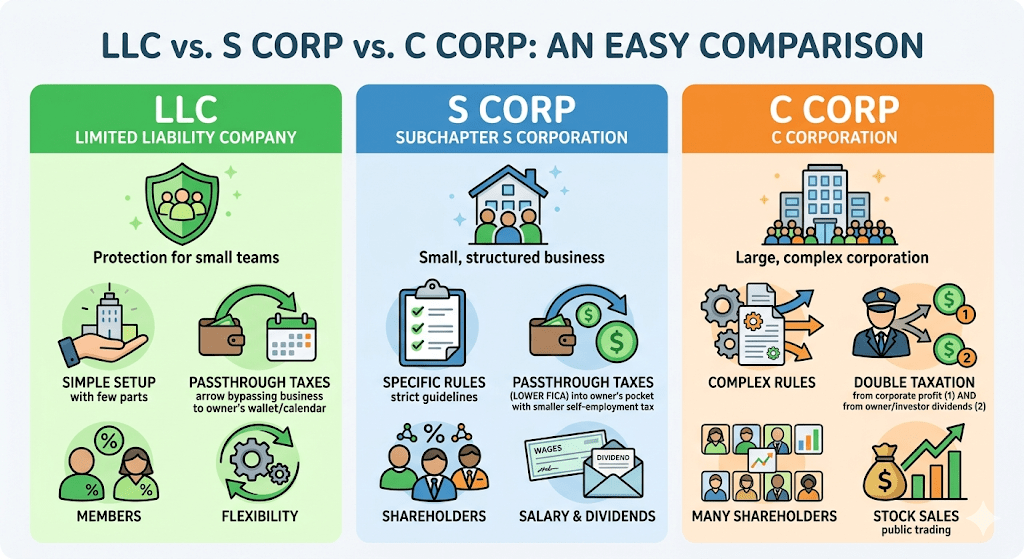
A limited liability company (LLC) is a legal structure that provides limited liability protection. An S corporation (under Subchapter S) is a tax election that can be applied to an LLC or corporation. A C corporation (under Subchapter C) is both a legal entity and a separate tax system.
This is why many professionals choose an LLC S corp structure, where a limited liability company elects S corp status through an IRS form. This combination allows for flexibility while maintaining strong liability protection and potential tax advantages.

LLC: The Foundation of Liability Protection
A limited liability company is often the starting point because it provides a clear separation between your business and your personal assets.
This separation is critical for reducing personal liability. If structured correctly, an LLC helps ensure that business liabilities do not automatically extend to your personal finances, including your home, savings, and investments.
For many professionals, this is the first step away from operating as a sole proprietorship, which offers no separation and exposes the owner to full liability.
A single member LLC is one of the most common setups for independent professionals. In this structure, the LLC owner maintains full control while still benefiting from limited liability protection.
However, it is important to understand that an LLC alone does not create a tax advantage. By default, income from a limited liability company is treated similarly to a sole proprietorship, meaning all profits may be subject to self-employment taxes, including Social Security and Medicare.
This is where additional planning becomes essential. Contact Legally Mine Now!
S Corporation: The Tax Efficiency Strategy
An S corporation is where tax strategy becomes more advanced. Rather than being a separate business entity, an S corp is a tax designation made under Subchapter S.
Through an S corp election, business owners can change how income is taxed. Instead of treating all income as self-employment income, S corp taxation allows income to be divided between salary and distributions.
This structure is particularly valuable for high-income earners. The salary portion is subject to payroll taxes, including Social Security, while distributions are not subject to the same level of self-employment tax.
For many S corp owners, this creates a meaningful tax advantage when implemented correctly.
However, S corps come with requirements. Owners must pay themselves reasonable compensation, maintain proper documentation, and follow compliance rules. This includes running payroll and maintaining records that can withstand IRS scrutiny.
Because of these requirements, S corps are not just about saving money, they are about structuring income correctly within the rules.
C Corporation: Built for Scale and Investors
A C corporation is a more traditional corporate structure. Unlike pass-through entities, a C corp pays corporate income tax at the entity level.
If profits are distributed to shareholders, those distributions may be taxed again at the individual level. This is often referred to as double taxation and is one of the main reasons many small business owners avoid a C corporation.
However, a C corp has advantages in specific scenarios. Businesses seeking venture capital, planning for rapid growth, or requiring multiple classes of ownership often use this structure.
A C corporation also supports a more formal ownership structure and management structure, including boards, annual meetings, and defined roles for shareholders.
While this may not be ideal for most medical practices, it can be useful in situations where scalability and outside investment are priorities.
Learn How Legally Mine Can Help YOU!
Key Differences That Actually Matter
When comparing entity types, the real decision comes down to how each structure impacts liability, taxes, and long-term flexibility.
An LLC provides strong limited liability protection and flexibility. An S corporation builds on that structure to create tax efficiency through S corp taxation. A C corporation introduces a separate tax system with corporate tax obligations but allows for more complex ownership and investment opportunities.
Understanding these key differences is essential for choosing the right business structure.
What Medical Professionals Are Actually Choosing
Most high-income professionals are not choosing randomly between entity types. They are optimizing for three core outcomes: liability protection, tax efficiency, and long-term flexibility.
Because of this, many physicians ultimately choose an LLC taxed as an S corporation. This approach combines the legal protection of a limited liability company with the tax advantages of S corp status.
This structure helps protect personal assets while reducing unnecessary tax exposure, making it one of the most practical solutions for profitable practices.

Real-World Example
Consider a physician earning $350,000 annually operating under a basic LLC.
Without an S corp election, that income is typically treated as self-employment income, exposing the full amount to payroll taxes.
By electing S corp status and structuring income properly, a portion of that income can be treated as distributions rather than wages. This reduces exposure to Social Security and self-employment taxes while maintaining compliance.
The difference is not just the business entity it is how the structure is used.
Schedule Your Consultation Now!
Common Mistakes to Avoid
Many professionals assume that forming a limited liability company is enough. In reality, failing to layer in tax strategy can lead to missed opportunities.
Others elect S corp status without understanding compliance requirements, which can create risk if not properly maintained. Mixing business and personal finances is another common issue that weakens liability protection.
Some also fail to update their structure as their income grows, leaving them in an outdated setup that no longer serves their needs.
Beyond LLCs: Other Structures to Know
While less common, structures such as a limited partnership or a foreign corporation may be used in more advanced planning strategies. In these setups, a limited partner may have ownership without management control, depending on the structure.
These strategies are more complex and typically used alongside broader tax planning and asset protection strategies.
Learn How Legally Mine Structures for You!
The Bigger Picture: Structure + Strategy
Choosing a business structure is not just about selecting an entity type. It is about aligning your structure with your income, risk level, and long-term goals.
A corporation, LLC, or S corp can all be effective tools, but only when used correctly. Without planning, even the best structure can fail to deliver results. The real goal is to create a system that reduces liability, protects personal assets, and maximizes tax efficiency over time.
Final Thoughts
The difference between an LLC, an S corporation, and a C corporation is not just technical it is strategic.
The right structure can reduce personal liability, improve liability protection, and create meaningful tax savings. The wrong structure can leave money on the table and expose you to unnecessary risk.
If your current business structure has not been reviewed recently, there is a strong chance it is not optimized for where you are today. Understanding how these structures work together and not just individually is what allows medical professionals to protect what they earn and build long-term financial security.
Contact Legally Mine Today and Start Now!
Frequently Asked Questions
Is an S corp a separate business entity?
No. An S corp is a tax election made under Subchapter S, not a standalone business entity.
Does an LLC provide liability protection?
Yes. A limited liability company helps separate business and personal assets, reducing personal liability when properly maintained.
What is the main benefit of S corp taxation?
S corp taxation allows income to be split between salary and distributions, which can reduce self-employment tax exposure.
Why do some businesses choose a C corporation?
C corporations are often used for scalability, especially when raising venture capital or creating complex ownership structures with shareholders.
Can I change my entity type later?
Yes, but changes should be made carefully to avoid tax consequences and compliance issues.
About Legally Mine
Legally Mine is a leading asset and lawsuit protection company that helps businesses and professionals proactively manage risk. Through specialized consulting and proven legal structures, Legally Mine provides practical tools to protect personal and business assets, reduce liability exposure, and give owners peace of mind, so they can focus on running their business with confidence.