

A revocable living trust and a will are not competing versions of the same document. A will directs your assets through probate court after you die. A revocable living trust moves those same assets outside that process, faster and out of public view. Neither one shields your practice or your savings from a creditor while you are alive.
Most physicians arrive at this question assuming one document can cover everything they own. Pick the right one, sign it, and the practice, the house, the brokerage account, and the rental in another state are all handled.
That is the assumption worth flipping. An estate plan is not one job. It is three, and the instruments that do them have names so similar that they get treated as interchangeable. A living will is not a living trust. A living trust is not an asset protection trust. Choosing correctly starts with knowing which of the three jobs your situation actually requires.
Not sure which layer you are missing? Schedule your free consultation with Legally Mine and get your current documents reviewed against your actual exposure.
Very few people have done any of this. A Pew Research Center survey of 8,750 U.S. adults, conducted in September 2025, found that 32 percent of American adults have created a will and 31 percent have a living will or advance health care directive. Among adults in their 60s, still only 46 percent had a will.

What a will actually does, and where it stops
A will is a set of instructions addressed to a probate judge. It names who receives what, who raises your minor children, and who administers the estate. It has no legal effect until you die and a court validates it.
That last point drives everything else. Because a will works through the court, the court’s timeline becomes your family’s timeline. A 2024 Trust and Will study of 1,000 Americans put the national average probate timeline at 20 months, and only 2 percent of respondents guessed anywhere near that figure.
For a physician who owns a practice, that timeline carries real risk. First there is a gap before the court appoints anyone to act. After that, the executor works under court supervision for months, while the practice still has payroll to meet, patients to see, and in many states a deadline to sell to another physician. Legally Mine takes that scenario apart in detail in how probate specifically threatens a medical practice.
A will also has three limits worth naming plainly:
- It is public. Once a will enters probate, it becomes a court record. So does the inventory of what you owned.
- It does nothing while you are alive. A will has no role if you are incapacitated rather than deceased.
- It stops at the state line. Real estate held in another state generally requires a separate ancillary probate proceeding in that state.
What an estate trust does that a will cannot
A revocable living trust is a legal container you create, fund, and control during your lifetime. You serve as your own trustee. You can move assets in and out, change beneficiaries, or dissolve it entirely. On incapacity or death, the successor trustee you named steps in without a court order.
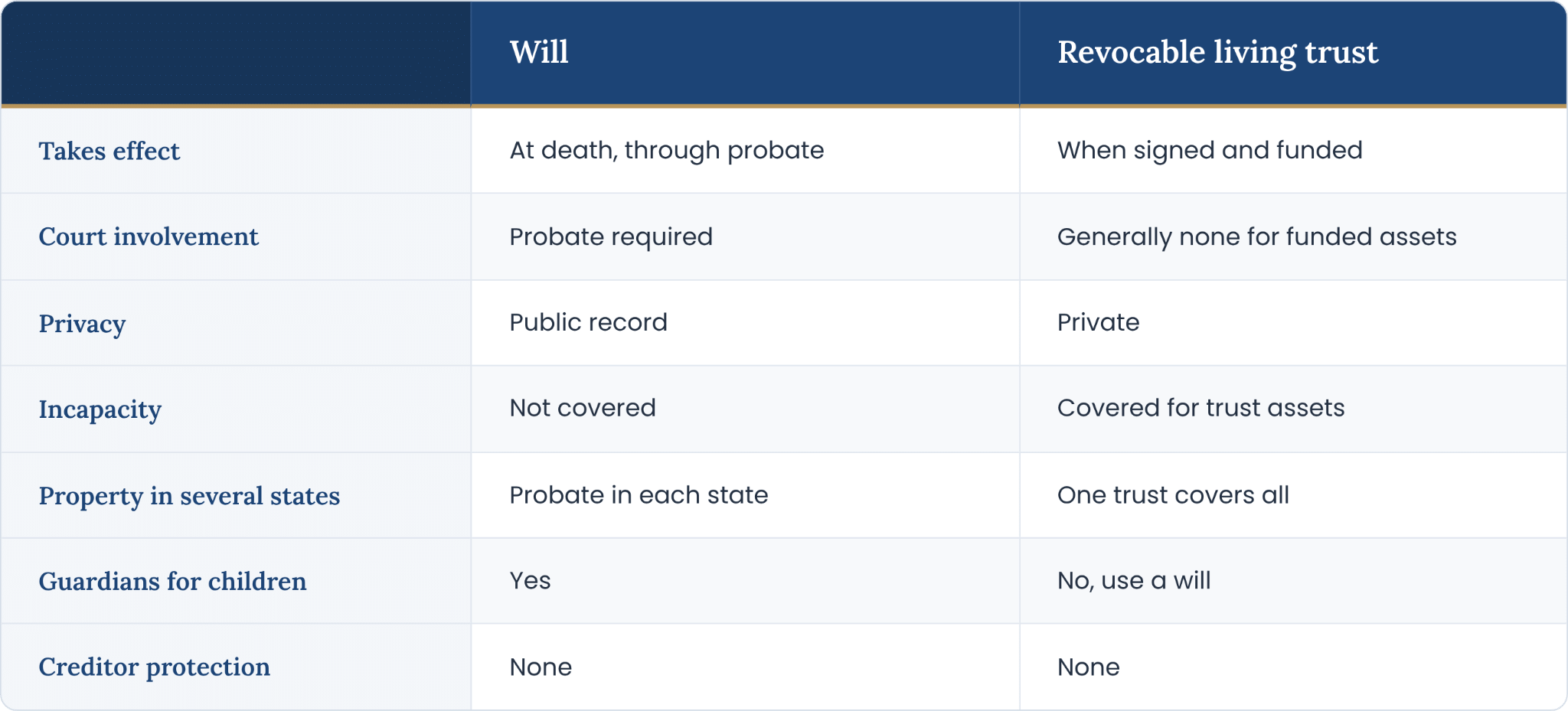
Book a free structure review and see which of these rows your current plan actually covers.
A living will, a living trust, and an asset protection trust are three different things
These three names cause more confusion in physician estate planning than any other set of terms, and the confusion is expensive because it leaves people believing a job is done that nobody has done.
A living will, sometimes called an advance directive, governs your medical care if you can no longer direct it yourself, and it only comes into play while you are alive and incapacitated. It says nothing about your house. A revocable living trust covers your house: it governs the ownership and transfer of whatever assets you put into it, and it matters at incapacity and at death. It says nothing about your ventilator. Physicians frequently have one and assume it covers the other.
Neither of them shields anything from a lawsuit. That is the job of the third instrument, an irrevocable or asset protection trust, which holds assets you have genuinely given up control over. It protects against future creditors, but only if it is funded well before a claim exists. For a doctor, this is the one that matters most, and it is covered in depth in Legally Mine’s breakdown of LLC versus irrevocable trust as an asset protection structure.
Why a revocable living trust gives you no asset protection
Search “living trust asset protection” and you will find pages implying the two are the same thing. They are not, and the reason is mechanical rather than legal hairsplitting.
Creditor protection follows control. A revocable trust leaves you in complete control: you are the trustee, you are the beneficiary, and you can undo the whole arrangement on a Tuesday afternoon. Courts therefore treat the assets inside it as still yours. A judgment creditor can generally reach them exactly as if the trust did not exist.
That gap matters more for physicians than for most people. The American Medical Association’s April 2026 Policy Research Perspective, drawing on its 2016 to 2024 Physician Practice Benchmark Survey, found that 28.7 percent of physicians had been sued at some point in their careers as of 2024. Among physicians aged 55 and over the figure was 45.2 percent, and among obstetricians and gynecologists it reached 59.6 percent.
Closing that gap takes a different class of structure, layered alongside the estate trust rather than instead of it:
- Professional entities, such as a PC or PLLC, which shield you from a partner’s malpractice and from many business debts, though not from claims arising from your own professional negligence
- Irrevocable trust structures, where assets are placed genuinely beyond your control, subject to fraudulent transfer rules that require acting well before a claim exists
- Separate LLCs or a holding company for rental property and investment real estate
- Malpractice and umbrella coverage, which remains the first layer and is not replaced by any of the above

The timing point is not a technicality. An irrevocable trust funded after a claim is already visible invites a fraudulent transfer challenge.
Your structure has to exist before a claim does. Talk to Legally Mine about your timeline.
When does a doctor need an estate trust instead of a will alone?
There is no net worth threshold that flips the answer. What flips it is the presence of specific conditions, and physicians tend to have several of them at once.
An estate trust is generally worth the added setup when any of these are true:
- You own a practice or a share of one. A practice needs someone with authority to run it on day two, not on month 20.
- You own real estate in more than one state. Each out-of-state property is a separate probate proceeding under a will.
- Privacy matters to you. Probate publishes what you owned and who received it. For a physician with a public-facing practice, that is a meaningful exposure.
- You want an incapacity plan for your finances, not just your medical care. A living will does not let anyone pay your practice’s payroll.
- You have a blended family, a special needs beneficiary, or heirs you want to receive assets over time rather than in one distribution.
For federal estate taxes, the threshold is high. The IRS instructions for Form 706, the federal estate tax return, set the basic exclusion amount at 15 million dollars for people who die in 2026, on a rate schedule that tops out at 40 percent. A surviving spouse can add the first spouse’s unused exclusion to their own, which can bring the total to 30 million dollars, but that transfer is not automatic. The executor of the first estate has to elect it by filing a complete Form 706 on time, even when that estate owes nothing. Lifetime gifts draw against the same 15 million, because the tax applies to transfers made during life and at death together. States can also levy their own estate or inheritance taxes, which is a state-by-state question worth asking.
Do I need both a will and a trust?
Yes, in nearly every case. A revocable trust and a will are not alternatives, and physicians who fund a trust and then discard the will create a new gap.
A trust only governs what is actually titled into it. Anything you forget to transfer, or acquire later and never retitle, sits outside the trust and passes under whatever instructions exist. That is the job of a pour-over will: it catches the strays and directs them into the trust.
A will also does two things a trust cannot. It names guardians for minor children, and it names the executor who handles anything the trust does not.
The related failure is an unfunded trust. A signed trust document with no assets retitled into it is a folder, not a plan, and everything it was supposed to cover goes through probate anyway. Retitling deeds, updating account registrations, and reviewing beneficiary designations is the unglamorous half of the work, and it is where most plans quietly fail.

How Legally Mine builds the estate trust layer for medical professionals
Legally Mine does not give legal advice and we do not form an attorney-client relationship. We build the structures, and attorneys handle the legal documents.
In practice, that means we start by mapping what you own and how each piece is currently titled, because the title, not the document, decides what happens. We then design the layers: which assets belong in the estate trust for transfer and privacy, which belong in entities for liability separation, and which need irrevocable treatment for creditor exposure. Licensed attorneys draft and review the documents for your state. Your CPA and your financial planner stay exactly where they are, and we coordinate the structure around the advice they are already giving you.
For the estate planning side of that work, see Legally Mine’s estate planning service for medical professionals. For the liability side, see asset protection.
Schedule a free consultation and we will start with what you own and how it is titled.
Where to start this week
If your estate plan is a will and nothing else, the useful next step is not choosing between a will and an estate trust. It is finding out which of the three jobs your current documents actually do, and which ones nobody has done.
Pull your documents. Check whether anything has been retitled. Check whether the practice has a named successor. If the answers are unclear, that is the gap, and gaps in an estate plan are only fixable while you are here to fix them.

Book your free consultation with Legally Mine and get a clear picture of what your plan covers and what it does not.
Frequently asked questions
Does a living trust protect my assets from a malpractice claim?
No. A revocable trust leaves you in control of the assets inside it, so courts generally treat those assets as reachable by your creditors, including a plaintiff holding a judgment. The trust handles transfer, privacy, and incapacity. Creditor exposure requires separate structures, layered alongside it and put in place before a claim exists. Legally Mine breaks down what those layers look like in the asset protection strategies physicians wish they had known sooner.
What is the difference between a living will and a living trust?
A living will, also called an advance health care directive, states your wishes for medical treatment if you cannot state them yourself. A living trust governs ownership and transfer of the assets you place in it. They cover completely different territory, and having one does nothing for the other. A complete estate plan for a physician typically includes both, along with a durable power of attorney. Legally Mine’s guide to what actually changed for physician estate planning in 2026 covers how these pieces fit together.
What happens to my medical practice if I only have a will?
The practice enters probate with the rest of your estate, and no one has clear authority to operate it until the court appoints someone. With probate taking roughly 20 months on average, staff, patients, and payer relationships are exposed while the estate works through the court. A trust with a named successor trustee, combined with a succession agreement, avoids that gap by giving someone the authority to keep the practice running from day one, without waiting on a court order. Legally Mine covers the continuity side in business succession planning for your practice or LLC.
About Legally Mine
Legally Mine is a leading asset and lawsuit protection company that helps businesses and professionals proactively manage risk. Through specialized consulting and proven legal structures, Legally Mine provides practical tools to protect personal and business assets, reduce liability exposure, and give owners peace of mind, so they can focus on running their business with confidence.
Disclaimer
The information provided on this website does not constitute legal advice or tax advice. Customers of Legally Mine have no attorney-client privilege with representatives of Legally Mine, and no confidential relationship exists or will be formed by using its services. For personal legal or tax advice, please consult a licensed attorney or personal accountant.