

A malpractice lawsuit can reach your home in some states, but only in narrow circumstances. It takes a judgment above your insurance limits plus home equity above your state’s homestead exemption. Most claims never get there. The catch is that physician liability does not stop at your policy limit, and protection only works if it already exists.
Most physicians treat the malpractice policy as the end of the conversation. One case in the medical literature shows why that assumption has a gap in it.
Orthopaedic surgeon B. Sonny Bal, MD, writing in Clinical Orthopaedics and Related Research in December 2024, walked through Downs v. Trias. Ahead of trial, a Connecticut gynecologist asked his carrier to settle at his $1 million policy limit. The carrier refused and went to trial.
The jury returned $4 million, and in 2012 the Connecticut Supreme Court affirmed the verdict. The plaintiff’s law firm then seized the physician’s personal and business bank accounts and placed a lien on his property. The case eventually settled for a confidential amount, and neither the physician nor his practice paid anything personally. Still, the firm froze his accounts first, and his exposure was real the entire time.
Not sure where your own gaps sit? Schedule a free consultation and we will walk through what your current setup covers and what it leaves open.
What to take from this post:
- A malpractice judgment reaches your home only when it exceeds your coverage and your equity exceeds your state’s homestead exemption.
- Facing at least one lawsuit over a career is common. Losing personal assets to a malpractice claim is rare. Losing personal assets to a malpractice claim is rare.
- The claims most likely to reach you personally are the ones malpractice insurance was never written to cover.
- An LLC or professional corporation does not shield you from liability for care you personally provided.
- State law shapes your exposure. Utah’s H.B. 503, for example, limits collection against covered physicians in malpractice cases, and it does nothing for any other kind of lawsuit.
- Risk mitigation only works when the structure exists before a claim does.
How often do physicians actually face malpractice lawsuits?
Facing at least one lawsuit is a realistic possibility across a full career, even for physicians who never make a mistake.The American Medical Association’s April 2026 Policy Research Perspective on medical liability claim frequency, drawn from its Physician Practice Benchmark Surveys, found that 28.7% of physicians had faced at least one lawsuit as of 2024, down from 34.0% in 2016.
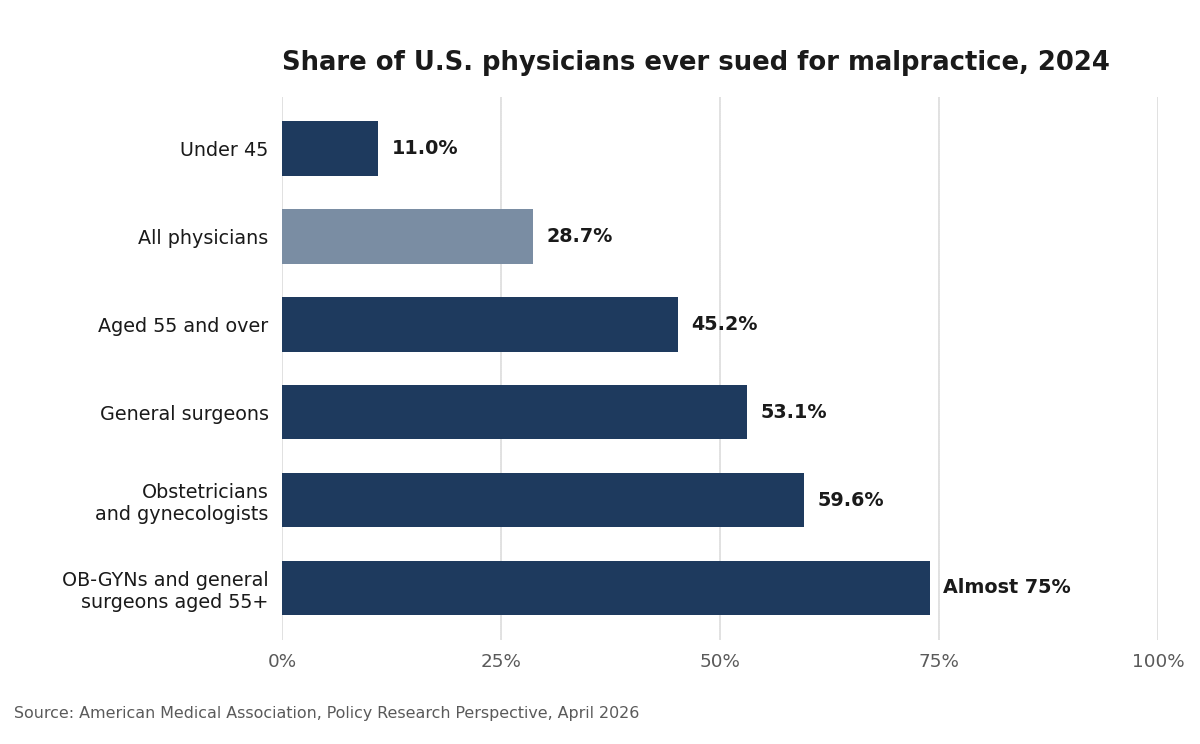
- 59.6% of obstetricians and gynecologists had faced at least one lawsuit
- 53.1% of general surgeons had faced at least one lawsuit
- Almost 75% of obstetrician-gynecologists and general surgeons aged 55 and over had faced a lawsuit
- 1.8% of all physicians faced a lawsuit in the previous year
A claim is not a finding of fault. Bobby Mukkamala, MD, the AMA’s president when the research was released, put it this way: “Physicians know the practice of medicine carries risk, and even highly skilled doctors face lawsuits. But a claim does not mean a mistake was made. Most cases never find fault with the physician, and the majority are dropped or dismissed before trial.” The AMA tied the persistence of that risk to costs well beyond the individual doctor: higher practice expenses, more defensive medicine, and healthcare costs that land on patients and families.
Two facts sit side by side here. Lawsuits are common over a career. Losing personal assets to a malpractice claim is rare. Asset protection planning exists for the distance between them.
What is professional liability, and why does it follow you personally?
Professional liability is your legal responsibility for harm caused by how you carry out your professional duties. For physicians, the familiar version is a medical malpractice claim: an allegation that care fell below the accepted standard and injured a patient.

Medical malpractice is a negligence claim, and that shapes how it proceeds. To win, a patient has to establish four things:
- That you owed them a duty of care
- That the care you gave departed from the accepted standard
- That the departure caused their injury
- That the injury produced real damages
A bad outcome on its own does not satisfy that test. Medicine carries risk that no amount of skill removes. Medical negligence means a specific failure against a professional standard, not a disappointing result, which is why so many claims against competent physicians go nowhere.
A medical error is not automatically negligence, a claim is not automatically an error, and a payment is not automatically a finding of fault.
The part that surprises people is that professional liability attaches to the individual who provided the care. It does not stop at the practice or the hospital where the care happened. A nurse’s error can pull in the supervising physician. A hospital’s policy failure does not erase the treating doctor’s own exposure.
That is the structural reason business entities do not solve this problem on their own. An entity can separate you from the practice’s liabilities. It cannot separate you from your own clinical judgment.
When does physician liability reach your personal assets?
Physician liability reaches personal assets when something breaks the link between the claim and the insurance meant to absorb it.
The verdict exceeds your policy limits
Malpractice policies in the United States usually provide up to about $1 million per claim, with a $3 million limit for all claims in the policy period, according to the Clinical Orthopaedics and Related Research column. When a verdict lands above those limits, the remainder becomes a judgment against you personally, collectible through liens on real estate and levies on bank accounts.
How large those verdicts run depends heavily on specialty. The same column points to a national database study of orthopaedic malpractice claims between 2015 and 2020. For orthopaedic cases overall, 25.6% resulted in verdicts favoring plaintiffs, with a mean indemnity payment of $7,702,576. The column is careful to note that studies built this way leave out cases a judge dismissed, cases settled before trial, and cases simply abandoned, so that share is not the odds of any single claim ending in a verdict against you. What the figure does show is the size of the verdicts that do land, and $7.7 million is well past a standard policy.
The column also raises a point physicians rarely consider. An attorney holding a judgment the insurer cannot cover, who knows the defendant has unprotected assets, may have a duty to pursue them, because leaving collectible money on the table could expose that attorney to a malpractice allegation from their own client.
The claim falls outside your coverage
Every medical malpractice insurance policy carries exclusions, and physicians rarely read them until a claim arrives. Intentional acts, care delivered outside your stated scope, sexual misconduct allegations, and services rendered while your license was lapsed are common carve-outs. A carrier’s insolvency, a non-renewal, or an unpaid premium produces the same result from a different direction: a real claim with no policy behind it. Gaps also open whenever a claims-made policy ends without tail coverage in place.
A lawsuit names you through your practice
Practice owners get pulled into claims arising from partners, employees, or the business itself. Even when you are not personally at fault, your ownership stake in the practice is an asset a judgment creditor can pursue.

What does professional liability insurance cover, and where does it stop?
Professional liability insurance, usually called malpractice insurance, is the first layer of protection for most physicians. It is essential, and it also covers less than most doctors assume. Each item below pairs what a policy generally covers with where that coverage stops.
- Defense costs: covered on a covered claim, but not when you are defending conduct your policy excludes.
- Settlements: covered up to your policy limit. Any settlement dollar above that limit is not.
- Judgments: covered up to your policy limit. Any amount above that limit can be collected from you personally.
- Claim timing: covered when the claim is reported while the policy is active. A claim that surfaces after a claims-made policy ends with no tail coverage is not.
- Type of claim: covered when the harm arises from patient care you delivered. Lawsuits with nothing to do with patient care, such as a car accident, a rental property injury, an employee dispute, or a business debt you personally guaranteed, are not.
Two details deserve a closer look:
- Personal umbrella policies generally exclude professional liability, so an umbrella does not quietly raise your malpractice limits. Read your own policy language rather than assuming.
- A paid claim joins your professional record even when insurance covered every dollar. Federal rules require the entity making a malpractice payment on your behalf to report it to the National Practitioner Data Bank within 30 days of the payment. The Data Bank’s guidebook, published by the Health Resources and Services Administration, also requires a copy of the processed report to go to the appropriate state licensing board in the state where the act or omission behind the claim occurred. State medical boards can query the Data Bank directly as well.
Professional liability insurance is not the same as general liability insurance
Practice owners frequently carry both and assume one backstops the other. It does not work that way.
Medical malpractice insurance, also sold as medical liability insurance, responds to claims about the care you delivered. General liability insurance responds to claims about your premises and operations, such as a visitor who falls in your waiting room. A patient injured by a treatment decision is a professional liability claim. The same patient injured by a loose floor tile is a general liability claim. Neither policy reaches into the other’s territory, and a practice carrying only one has an open flank.
Two questions are worth putting to your insurance company in writing:
- Does your medical malpractice coverage extend to everyone practicing under your supervision, including physician assistants and nurse practitioners, or do they carry separate professional liability coverage?
- Does the policy’s insurance coverage include administrative proceedings such as a licensing board investigation, which often arrive alongside a claim and are not always included?
Claims-made policies create gaps that occurrence policies do not
Most insurers today write physician malpractice coverage on a claims-made basis. A claims-made policy covers a claim only if the policy is active when you report the claim, not when the care happened. An occurrence policy covers care delivered during the policy period no matter when the claim shows up, which is why it costs more.
The gap opens at transitions. Leave a practice, change carriers, cut back to part time, or retire, and every patient you treated under the old claims-made policy becomes uninsured the moment that policy ends. Tail coverage, formally extended reporting period coverage, closes it. So does prior-acts coverage from the incoming insurance company. Skip both and medical malpractice claims arising from work you did years ago arrive with nothing behind them.
Malpractice insurance is one layer of legal risk management, not the whole plan. The rest of the plan has to account for the lawsuits insurance was never built to cover, which is the work behind our lawsuit prevention services.
Every physician has gaps somewhere in this list. Book a free consultation and get a straight read on where yours are.
Does an LLC protect a physician from malpractice?
An LLC or professional corporation does not protect a physician from liability for their own malpractice. No business entity erases personal responsibility for care you personally provided. Any structure sold to you on that promise is being oversold.
A properly run entity still does real work. A professional LLC or professional corporation can separate your personal assets from other practice liabilities, including:
- Vendor and lease disputes
- Employee claims against the practice
- Premises injuries at your office
- Business obligations you did not personally guarantee
That separation depends on how you run the entity, not on the fact that it exists. Courts can disregard an entity, a step called piercing the corporate veil, when owners mix personal and business funds, skip required filings, or treat the business account as a personal one.
Entity choice also shapes your tax picture, not only your liability. Our breakdown of LLC vs. S Corp vs. C Corp for medical professionals covers how physicians weigh both at once.

Which assets carry protection, and which do not?
When physician liability turns into a judgment, some assets carry creditor protection by default. Others are fully reachable. The rules vary substantially by state, so treat the two lists below as a starting point and confirm your own state’s law.
Assets that often carry protection
- Employer retirement plans covered by ERISA, such as a 401(k) that includes non-owner employees
- Primary home equity, up to your state’s homestead exemption
- IRAs and solo 401(k)s
- Certain life insurance and annuities
- Property held as tenancy by the entirety, in the states that allow it
Assets a judgment creditor can usually reach
- Checking and savings accounts
- Taxable brokerage accounts
- Rental properties and second homes
- Your ownership stake in a practice
- Vehicles, collectibles, and valuables above exemption limits
Employer retirement plans are the strongest item on either list, because the Employee Retirement Income Security Act generally shields them from creditors. A solo 401(k) covering only you, or you and a spouse, is not an ERISA plan, so its protection outside bankruptcy turns on your state’s law. Once money leaves any protected account, it becomes ordinary cash a creditor can reach.
Homestead protection is what decides whether a malpractice judgment can reach your home. Your state’s homestead exemption sets how much home equity is off limits. Equity above that line can carry a judgment lien. Exemptions range from nearly unlimited in a few states to tens of thousands of dollars in others, which is why the same physician faces very different exposure in two different states.
Most physicians have never had anyone sort their assets into those two lists. Request a free consultation and we will map it with you.

What changed for Utah physicians under H.B. 503?
Utah physicians gained meaningful protection in 2025. H.B. 503 amended the Utah Health Care Malpractice Act and added Utah Code Section 78B-3-405.5, effective May 7, 2025. Subsection (4) states that a plaintiff “may not pursue, collect, or execute on a judgment against an individual health care provider’s personal income or assets,” unless the court finds that:
- The provider’s conduct was willful and malicious or intentionally fraudulent
- The provider failed to maintain an insurance policy with a policy limit of at least $1,000,000
The same section also bars a plaintiff, before any award of damages, from making allegations the court
finds irrelevant to the claims, made primarily to coerce or induce settlement, and pertaining to a provider’s personal income or assets.
For a Utah physician carrying at least $1 million in coverage, that is a real shift in malpractice risk. It does not make asset protection unnecessary, because the protection is narrower than it first sounds:
- It applies to malpractice actions. A car accident, a slip and fall at a rental property, an employee lawsuit, or a personally guaranteed practice loan sits outside it entirely.
- It depends on your coverage. Let the policy lapse or fall below $1 million and the protection goes with it.
- It has exceptions. Conduct a court finds willful and malicious or intentionally fraudulent is not covered.
- It is Utah law. If you practice, own property, or hold licenses in other states, those states’ rules govern there.
- It follows the Act’s definition of health care provider. Section 78B-3-403 lists physicians, physician assistants, registered and practical nurses, nurse-midwives, dentists, dental hygienists, optometrists, pharmacists, physical therapists, podiatric physicians, psychologists, chiropractic physicians, naturopathic physicians, osteopathic physicians, clinical social workers, and others. Veterinarians are not on that list.
Health care providers outside that definition get no protection from the statute at all. That gap is one reason we wrote separately about asset protection for veterinarians. We work alongside the attorney on your plan to confirm how the statute applies to your situation. For Utah physicians, every lawsuit outside malpractice still calls for the same planning it always did.
What does risk mitigation look like beyond insurance?
Risk mitigation against physician liability has three layers, and most doctors are carrying only the first one.
The first layer is coverage. Confirm your per-claim and aggregate limits on your medical malpractice insurance, check whether the policy is claims-made or occurrence, and find out what happens to your tail if you leave. Ask your insurance company specifically whether an excess layer is available that actually sits over professional liability coverage, since most personal umbrellas do not.
The second layer is structure. How you title your home, which entity holds the practice, whether investment real estate sits inside the same entity as your clinical work, and whether retirement savings live in an ERISA plan or a solo plan all change what a judgment creditor can reach.
The third layer is timing, and it is the one that cannot be fixed later. The American Medical Association reported in April 2026 that 2025 was the seventh consecutive year medical liability premiums trended upward.
The share of premiums rising year over year went from 13.7% in 2018 to 49.8% in 2024, easing to 39.9% in 2025. Eleven states recorded at least one premium increase of 10% or more in 2025.
Rising premiums raise the cost of a layer that was never going to cover everything, and they do nothing about what that layer excludes.
Talk with our team and we will walk your plan through all three layers to find the thin spots.
When should physicians set up asset protection?
The right time is before a claim exists or anyone can reasonably foresee one. Every strategy in this field depends on that sequence.
Courts can undo transfers made to escape a creditor. Utah’s Uniform Voidable Transactions Act, for example, provides at Section 25-6-202 that a transfer is voidable as to a creditor, “whether the creditor’s claim arose before or after the transfer was made,” if the debtor made it with actual intent to hinder, delay, or defraud any creditor. Other states have similar voidable transfer laws, and federal bankruptcy law allows similar reversals.
Retitling accounts or moving a home into a trust after a bad outcome usually damages your position rather than helping it. Our post on whether you can protect assets after being sued covers how fast that window closes.
Do-it-yourself planning carries its own risk. The Clinical Orthopaedics and Related Research column describes a Kentucky neurosurgeon who transferred his home to his wife, expecting it to keep the house safe from a future lawsuit. The couple divorced years later.
He argued in court that the transfer had been a fraudulent transfer meant to avoid future creditors and asked the court to set it aside. The appeals court instead held that he had made a binding gift, treated the understanding that the home would come back to him on divorce as unenforceable, and he lost the house.The column’s own conclusion is worth sitting with: the odds of divorce in the United States are greater than the risk of a large medical malpractice verdict.
Good moments to review a plan include finishing training, buying into a practice, buying a home or rental property, marrying, and any significant jump in income or net worth. Treat it as a standing review rather than a one-time project.
How Legally Mine helps physicians protect personal assets
Legally Mine works with physicians, dentists, veterinarians, and other healthcare professionals to build protection before a claim exists. We are not a law firm and not a CPA firm. We build the structures, attorneys handle the legal documents, and we coordinate with the attorney, CPA, and financial planner you already work with so your entities, insurance, and estate plan line up instead of contradicting each other.
That work usually spans three services:
- Asset protection: structuring how you own your home, your practice, and your investments
- Lawsuit prevention: identifying the claims your insurance does not cover
- Estate planning: structuring your estate so what you build passes to the people you choose
We build every plan around your state, your specialty, and what you actually own. Cost is an initial setup fee plus annual maintenance, and you see the exact figures before you sign anything.

Protect what you have built before a claim tests it
A malpractice lawsuit taking a physician’s home is uncommon, and in states with strong homestead protection it is harder still. Physician liability still reaches personal assets when a verdict outruns coverage, when a claim lands in a gap, or when the lawsuit has nothing to do with patient care at all. Closing those gaps early is what gives a plan time to work.
Schedule your free consultation and find out which of your assets a judgment could reach today.
Frequently asked questions
How much of my home does a homestead exemption protect?
A homestead exemption shields some or all of the equity in your primary home from most judgment creditors, and how much depends on your state. Exemptions range from nearly unlimited in a few states to tens of thousands of dollars in others. Equity above the exemption can carry a judgment lien, which rarely forces an immediate sale but can pressure you to pay through a refinance or a later sale. Our asset protection strategies for physicians cover how you title your home and how much of its equity sits exposed.
Is malpractice insurance enough to protect a physician’s assets?
Medical malpractice insurance is a necessary first layer, not a complete plan. It covers defense costs, settlements, and judgments up to your limits. It does not cover amounts above those limits, excluded conduct, claims that fall into a coverage gap, or lawsuits unrelated to patient care such as car accidents, rental property injuries, or employee disputes. Risk mitigation past that first layer is a matter of structure and timing, and we go deeper on whether you still need protection if you already have insurance.
Can a physician protect assets after a lawsuit?
Protecting assets after a lawsuit starts is difficult and frequently backfires. State voidable transaction laws and federal bankruptcy law let courts reverse transfers made to hinder, delay, or defraud a creditor, and a late transfer can weaken your position in the underlying case. Asset protection depends on the structure existing before a claim does. Our guide to what asset protection actually is explains how the pieces fit together.
Disclaimer
The information provided on this website does not constitute legal advice or tax advice. Customers of Legally Mine have no attorney-client privilege with representatives of Legally Mine, and no confidential relationship exists or will be formed by using its services. For personal legal or tax advice, please consult a licensed attorney or personal accountant.