

Retiring or selling your practice does not end your malpractice exposure. Patients can file claims years after the care they received. If your medical malpractice insurance is a claims-made policy, it responds to none of those claims once it ends, unless you have malpractice tail coverage in place. Meanwhile, the proceeds of a sale often land in accounts a judgment creditor can reach.
Most physicians picture the last day of practice as a finish line. The final patient is seen, the buyer takes the keys, and the liability that came with clinical work seems to stay behind with the charts. The law does not treat it that way, and a claim does not need your practice to still exist.
Exposure also builds with time in practice. The American Medical Association’s April 2026 research on claim frequency found that 45.2% of physicians aged 55 and over had been sued at least once in their career. Among physicians under 45, the figure was 11.0%. The physicians closest to retirement carry the longest record of care that a former patient could still question.
Planning to sell or retire in the next few years? Schedule a free consultation and we will walk through what stays exposed after you stop practicing.
Your last patient isn’t your last claim
Physicians often become more attractive targets after they stop practicing, not less. Three things change at the exit, and each one works against you if your structure stays exactly as it was.
- Your net worth is near its peak. Decades of savings, a paid-down home, and the value of the practice are often at their highest when you leave.
- Sale proceeds arrive as cash. That money usually lands in a bank or brokerage account in your name, among the easiest assets for a judgment creditor to reach.
- Your income stops. A working physician can absorb a loss against future earnings. A retired physician pays it from savings that are no longer being replaced.
Asset protection during a transition means arranging how you own what you have built, before the sale closes, so a claim larger than your malpractice insurance has less within reach. It does not change whether you are responsible for the care you provided. The asset protection strategies physicians rely on work the same way at retirement, but the exit compresses the timeline.

Can a physician lose personal assets in a malpractice lawsuit?
Yes, but only when a medical malpractice judgment exceeds your policy limits, falls outside what your policy covers, or arrives with no policy in place at all. For a retired physician, that last case matters most. A claims-made policy that ended without tail coverage can leave claims from years of past care with nothing behind them. Our post on whether a malpractice lawsuit can take your home explains how exemptions and state law decide what a judgment can reach.
Claims can arrive years after you stop practicing
Leaving practice does not close the window for a medical malpractice claim. The Medical Professional Liability Association’s state-by-state summary, current as of August 2026, shows that every state sets its own statute of limitations for these claims. Texas allows two years, with a ten-year maximum. Maryland pairs a five-year limit with a three-year limit measured from when the injury was discovered.
While some states can run even longer with no technical cutoff. Pennsylvania’s discovery rule, for example, allows for these delayed lawsuits to happen up to 2 years after a problem from malpractice was discovered which could be years after the initial treatment.
Occurrence vs. claims-made: which policy do you have?
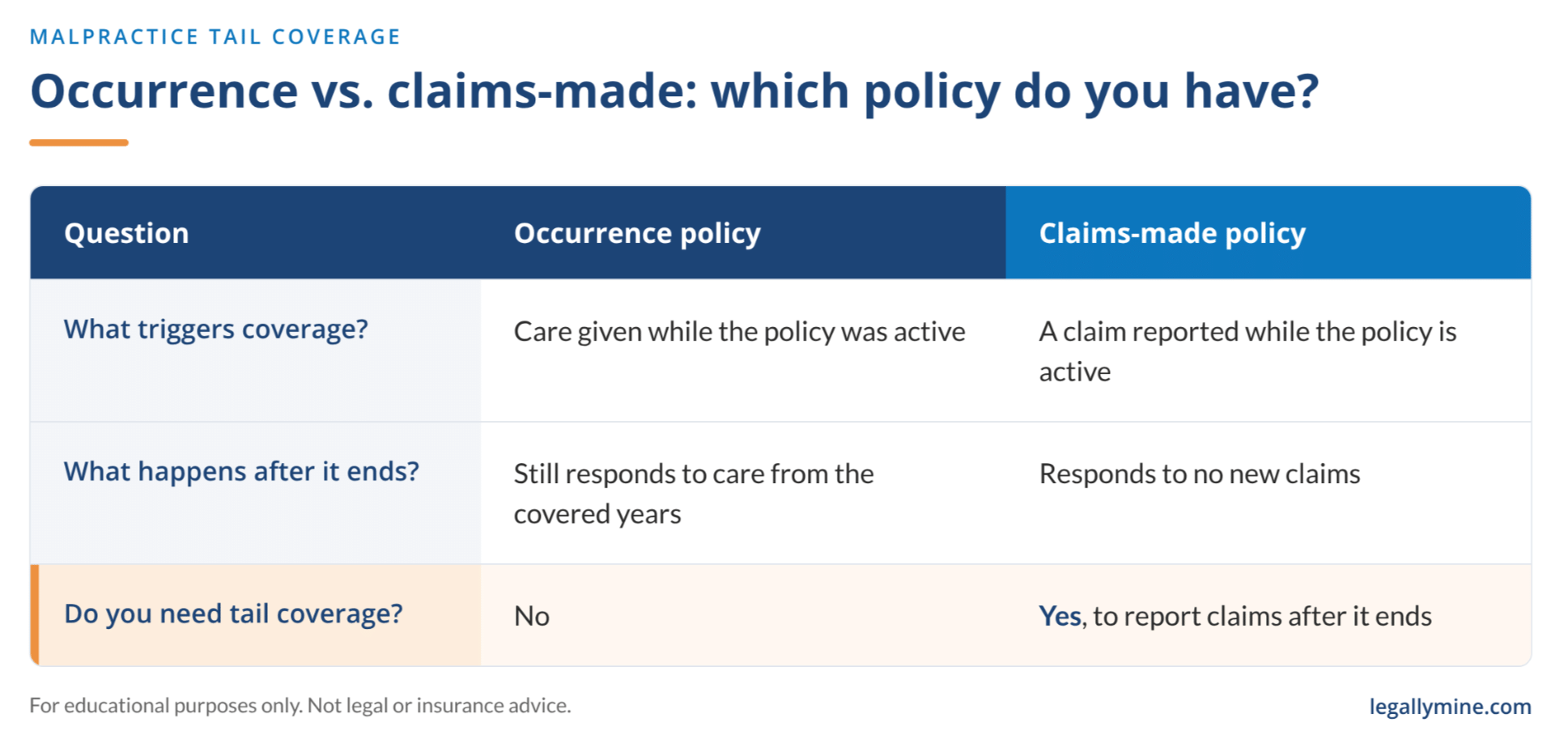
Professional liability policies come in two forms, and the difference decides what happens after your last day. Texas Medical Liability Trust, a medical liability insurer, says an occurrence policy provides “ongoing coverage for events that occur during the policy period,” even when the claim arrives after cancellation. A claims-made policy protects you during the current policy period, usually one year.
What is malpractice tail coverage, and do you need it?
Malpractice tail coverage, also called tail insurance, is an endorsement that lets you report claims after a claims-made policy ends, for care you gave while it was active. ProAssurance’s policy materials call it an extended reporting endorsement. Retire or sell without one, and claims reported afterward have no policy behind them.
Medical liability insurer MICA notes that a tail is typically priced as a percentage of the annual premium, with costs varying widely by carrier and state. Some carriers waive that premium at retirement, death, or disability, but the conditions matter. MICA, for example, offers a no-cost retirement tail only to policyholders who are at least 55, have been insured for at least a year, and completely retire from medicine.
A condition like that matters if you plan to keep working part time, take locum tenens shifts, or stay on as the buyer’s employee. If you keep practicing under a new carrier, ask whether it offers nose coverage, also called prior-acts coverage, which can cover claims from your earlier care in place of a tail. Put these questions to your broker in writing:
- Is my malpractice insurance claims-made or occurrence?
- What would tail insurance cost, and do I qualify for it at no additional premium?
- What counts as retirement, and would part-time or locum work disqualify me?
- How long after cancellation do I have to request the tail?
Your limits, your umbrella, and what sits above them
Tail insurance extends how long you can report a claim. It does not make the policy larger, so a verdict above your limits still lands on you personally, a gap we cover in I already have insurance. Do I still need this? If you carry a personal umbrella, ask your broker to walk through its exclusions before you count on it to cover what your medical malpractice insurance does not.
One point holds no matter how your coverage is arranged. No LLC, trust, or other structure changes your personal liability for care you provided. What planning changes is what a plaintiff can reach if a judgment goes beyond your coverage.
Closing a medical practice also brings duties that have nothing to do with insurance, including record retention and patient notification under your state’s rules. The AMA Code of Medical Ethics, in Opinion 3.3.1, asks physicians to tell patients how to access their stored records and for how long. Confirm your state’s requirements with your medical board and practice attorney.
Once you know where your coverage ends, book a free consultation to see what sits exposed beyond it.
Selling the practice: three questions for your attorney and CPA
Selling a medical practice is a legal and tax transaction first, and the answers to these questions belong to your attorney and CPA. Ask them early, while the deal terms can still change.
- Who keeps responsibility for past liabilities? The purchase agreement sets this out, including any indemnification terms, which are the promises about who pays if a claim tied to the practice surfaces after closing. Ask too whether the buyer will pay for your tail or provide nose coverage.
- Is the buyer purchasing the practice’s assets or the entity itself? The structure of the deal shapes both which liabilities can follow you and how the proceeds are taxed, so your attorney and CPA should weigh it together.
- Do your personal guarantees end at closing? Ask whether the landlord and lenders will release you, or whether a lease or loan you guaranteed stays your responsibility after the buyer takes over.
Legally Mine works alongside your attorney and CPA on what comes after those answers, so your structure is in place before the sale proceeds land.
Which assets are most exposed after the transition
The assets most exposed after a sale are the ones held in your own name, with no entity, trust, or exemption standing between them and a creditor. California’s court self-help guide, for example, lists levying a bank account and placing a lien on real estate among the standard ways to collect a judgment.
- Sale proceeds held as cash. A bank account can be levied to pay a judgment, which is where sale proceeds usually land at closing.
- The practice building or other real estate in your name. A judgment can become a lien on real estate, and the property can be sold to satisfy it.
- Home equity above your state’s homestead exemption. The exemption protects a set amount of equity, not all of it.
- Investment accounts titled to you personally. With no entity or trust in between, nothing separates the account from a creditor.
- High-risk holdings mixed in with everything else. A claim against one rental property or side venture can reach whatever is held alongside it.
Retirement accounts often sit in a different category. Depending on the type of account and your state, much of that money may carry creditor protection that a taxable account does not, which Layer 3 covers in more detail.

Few physicians have ever sorted their own assets this way. If you are not sure how yours are titled, a free consultation with Legally Mine is a practical place to start.
The four layers of an exit plan
An exit plan works in four layers, and each one does a different job. Leave one out and the others carry more weight than they were built for.
- Entities separate your assets from each other.
- Trusts separate ownership from you.
- Titling and exemptions use protections the law already provides.
- Timing decides whether any of it holds up when it is tested.
Layer 1: Entities
The first layer keeps what you own in separate compartments. Consider an illustrative example: a physician sells her practice but keeps the building in its own LLC and leases it to the buyer. The rent continues as income, and the structure is built so a premises claim from the buyer’s patients is aimed at the building’s LLC, not at everything she owns.
The same logic applies to rental properties and higher-risk investments. Holding each in its own LLC is designed to keep a claim against one from reaching the others or your personal accounts.
That separation only holds if you respect it. Cornell Law School’s Legal Information Institute notes that courts can set aside limited liability, a step called piercing the corporate veil. Abusing the entity, such as by intermingling personal and company assets, is the kind of misconduct that can justify it. Keep separate bank accounts, pay personal bills personally, and keep the entity’s records current.
State law also decides how well an LLC holds up against your own personal creditors. Florida’s statute makes a charging order, a court order letting a creditor collect distributions from your LLC interest, generally the exclusive remedy. For a single-member LLC, though, a Florida court can order your interest sold if distributions will not satisfy the judgment within a reasonable time.
A family limited partnership is another entity option, often used to hold a family’s investment assets under one managed structure. Whichever entities you use, decide with your attorney whether the practice entity itself stays open after the sale or is formally dissolved. Your attorney handles any dissolution filings, and an entity that stays open still needs ongoing compliance.
An LLC is one layer, not the whole plan. Our post on why an LLC alone isn’t enough protection explains where single-entity planning falls short.
Layer 2: Trusts
Trusts work by moving ownership away from you, and how far they move it decides how much protection they can offer. Three types come up most often in an exit plan.
Revocable living trusts do important estate work, keeping assets out of probate and passing them privately. They do not shield those assets from your creditors during your lifetime. Florida’s trust code, for example, states that the property of a revocable trust “is subject to the claims of the settlor’s creditors during the settlor’s lifetime.” Our guide to probate avoidance for physicians covers what a living trust is built to do.
Irrevocable trusts move assets out of your ownership for good, which is where their protective value comes from. If the trust can still pay out to you, though, state law may let your creditors reach that share. Under the same Florida statute, a creditor of the person who created an irrevocable trust “may reach the maximum amount that can be distributed to or for the settlor’s benefit.”
Domestic asset protection trusts are the exception some states make for trusts you create for your own benefit. Nevada’s statute allows an irrevocable trust that names its creator as a beneficiary, as long as it was not intended to hinder, delay, or defraud known creditors. It also limits the window: an existing creditor generally has two years after a transfer, or six months after discovering it if that is later, to bring an action.
Those rules reward planning that happens early. Our comparison of an LLC vs. an irrevocable trust explains when each structure fits.
Layer 3: Titling and exemptions
The third layer uses protections that already exist in federal and state law. They only help if your assets are held in a way that qualifies, and nearly every one depends on your state.
Retirement accounts. Protection depends on the type of account. Federal law requires employer retirement plans covered by ERISA to provide that benefits “may not be assigned or alienated,” which keeps them largely beyond a creditor’s reach.
IRAs lean more on state law. Florida, for example, exempts accounts maintained under the tax code’s IRA sections from all claims of creditors. In bankruptcy, federal law caps most IRA protection at $1,711,975 under the adjustment that took effect April 1, 2025. Before rolling a 401(k) into an IRA at retirement, ask your attorney and financial planner whether the move changes how that money is protected.
Your home. Homestead exemptions vary widely. Florida’s constitution protects a homestead with no dollar cap, limited instead by acreage: half an acre inside a municipality, 160 acres outside one. California’s exemption is the greater of $300,000 or the county’s median home price up to $600,000, with both figures adjusted for inflation each year since 2022.
Tenancy by the entirety. This form of ownership is available only to married couples, and not every state recognizes it. Where it applies, it can keep jointly owned property out of reach of one spouse’s separate creditors. Virginia’s code, for example, ties that immunity to the couple remaining married.
Life insurance and annuities. Some states exempt these as well. Florida’s statutes shield the cash surrender value of life insurance policies and the proceeds of annuity contracts from attachment or garnishment by creditors. Confirm your own state’s rules before counting on any of these.
Layer 4: Timing
Timing decides whether the first three layers hold up. Florida’s fraudulent transfer statute, for example, lets a court undo a transfer made with actual intent to hinder, delay, or defraud a creditor, whether the creditor’s claim arose before or after the transfer. A court may weigh signs such as a transfer made after the debtor was sued or threatened with suit, or shortly before or after a substantial debt was incurred. A creditor generally has four years to bring that challenge, or one year after discovering the transfer if that is later.
That is why retitling assets after a bad outcome can backfire. Our post on whether you can protect assets after being sued explains how quickly that window closes.
For a practice sale, the time to start is while the sale is still a plan: before you announce it, before you sign a letter of intent, and well before closing. Structures built then can become part of the deal, such as moving the building into its own LLC before the lease to the buyer is signed. Wait until the proceeds land, and you are making decisions under pressure with your largest pool of cash already exposed.
The strongest plans start before the sale is public. Talk with Legally Mine before you sign a letter of intent.
What doesn’t work
Is asset protection legal? Yes, when it is set up before a claim exists, using entities, trusts, and exemptions that state and federal law provide for. Plans fail because of how and when they were used, not because the structures themselves are suspect. Florida’s fraudulent transfer statute lists the warning signs a court may weigh, and three common shortcuts match them directly:
- Moving assets after a claim or dispute starts. A transfer made after you were sued or threatened with suit is one of the listed signs.
- Putting assets in a relative’s name while keeping control. A transfer to an insider, which includes a relative, is a listed sign, and so is keeping possession or control of the property afterward.
- Hiding assets. Concealing assets, or concealing the transfer itself, is on the list as well.
Can physicians hide assets from creditors? No, and a plan that depends on secrecy is a weak plan. Privacy can make you a less attractive target, but the protection itself has to hold up once a creditor knows exactly what you own.
Building your exit plan
A workable exit plan follows a simple order:
- List what you own and how it is titled, including what the sale will turn into cash.
- Structure it using the four layers above, starting with whatever the sale will expose first.
- Coordinate with your attorney, CPA, and financial planner so the structure, the deal terms, and the tax picture line up.
- Update your estate plan after closing, because the practice it was built around is gone.
That last step is the easiest to skip. A sale replaces a practice interest with cash and investments, so new accounts need to be titled correctly, beneficiary designations need a fresh look, and any living trust needs to hold what replaced the practice. Our guide to estate planning basics for doctors and business owners walks through each piece.
Legally Mine’s role in an exit plan is structure and coordination. Our team maps what you own, designs the entities and trusts that fit it, and sets them up before the sale closes. Legally Mine is not a law firm or a CPA firm: a licensed attorney handles the legal documents, and your CPA and financial planner keep handling your taxes and investments. Working alongside all three, we make sure the pieces line up.
Cost is an initial setup fee plus annual maintenance, and you see the exact figures before you sign anything.

Your exposure does not end with your last patient. What it can reach depends on decisions you can still make before the sale.
Schedule your free consultation and build your exit plan while the sale is still yours to shape.
Key takeaways:
- A claims-made malpractice policy stops responding to new claims when it ends, unless you add tail coverage, formally called an extended reporting endorsement, or a new carrier provides nose coverage.
- No entity or trust changes your liability for care you personally provided. Planning changes what a plaintiff can reach if a judgment outruns your coverage.
- Sale proceeds sitting in a personal account are among the most exposed assets you will ever hold.
- Protection has to exist before a claim does, so the planning window closes earlier than most physicians expect.
Frequently asked questions
Can I be sued for malpractice after I retire?
Yes. Retiring does not close the window for a malpractice claim, because each state sets its own statute of limitations and some run for years. Texas, for example, allows up to a ten-year maximum to file a claim. If your policy was claims-made, malpractice tail coverage is what lets you report those claims after the policy ends. Our lawsuit prevention services focus on the exposure that remains after coverage stops.
Does a PLLC or LLC protect me from malpractice claims?
No entity protects you from liability for care you personally provided. A PLLC or LLC can separate your other assets from practice-level claims and keep one holding’s problems from reaching another, as long as it is run as a truly separate business. What it changes is what a plaintiff can reach, not whether you are liable. Our asset protection services are built around that distinction.
Is it too late to plan once the sale is announced?
Not necessarily. An announced sale is not a claim, so planning can still go forward, but what matters is whether a claim already exists or is threatened and whether a transfer looks designed to hinder a creditor. Starting before the letter of intent leaves the most room, because structures can be built into the deal itself. Planning before closing also leaves time to update your estate plan around what the sale produces.
Disclaimer
The information provided on this website does not constitute legal advice or tax advice. Customers of Legally Mine have no attorney-client privilege with representatives of Legally Mine, and no confidential relationship exists or will be formed by using its services. For personal legal or tax advice, please consult a licensed attorney or personal accountant.