

A holding company owns assets and the ownership interests in other businesses. An operating company runs the business that earns the revenue. Separating the two is a basic asset protection move: it puts imaging equipment, real estate, and retained cash in one entity while daily liability sits in another, so a claim against the practice has less to reach.
Consider an example. An orthopedic surgeon owns her practice through a single entity that holds the payroll, the building she bought four years ago, and roughly $900,000 in imaging equipment. A patient falls in the waiting area and sues. The claim has nothing to do with surgery, so the malpractice policy never engages, and the general liability policy pays its limit and stops. Everything the entity owns is now reachable, not because of her clinical work, but because of the structure.
Not sure which of your assets sit inside the entity taking the risk? Schedule your free consultation with Legally Mine and find out on paper.

What is a Holding Company?
A holding company is a business entity formed to own things rather than do things. It holds controlling interests in subsidiary companies, along with assets like real estate, equipment, and intellectual property, and it does not see patients, sell services, or employ clinical staff.
In small practices, the most common version is a holding company LLC, an entity formed solely to hold membership interests in other LLCs and the assets those businesses use, positioning it as the parent company above them.
Key characteristics: owns controlling interests in subsidiary companies and assets rather than producing goods or services; earns income from distributions, rent, and fees rather than customers; and usually has few or no employees beyond management.
Types of holding companies:
- Pure– owns interests in other entities and nothing else, the cleanest structure for asset separation.
- Mixed– owns subsidiaries and also runs a business of its own, which puts liability back into the entity meant to be insulated.
- Intermediate– sits in the middle of a larger group, owned by a top-level parent while directly controlling one or more operating companies below it. Groups with multiple subsidiaries use these; solo owners rarely need one.
Advantages of a Holding Company
The advantages come from separation: assets sit in one place, risk in another, and the line between them is legal rather than a matter of bookkeeping.
Liability protection and asset protection
Because the operating company owns very little, a judgment against it collects very little. This is the core reason most business owners pursue asset protection through a holding company in the first place. The risk is documented: the American Medical Association’s April 2026 Policy Research Perspective found 28.7 percent of physicians had been sued at some point by 2024, rising to 45.2 percent for those 55 and over. There’s a limit though, a physician generally remains personally liable for her own clinical negligence regardless of how her entities are structured. What a holding company protects is the assets held outside the practice entity, not the physician from her own malpractice claims, which is what professional liability insurance is for.
Tax benefits
A holding company can own real estate and lease it back to the operating company, creating a deductible expense on one side and rental income on the other, and pass-through structures avoid a second layer of tax at the entity level. Entity choice drives most of this, and Legally Mine breaks the options down in LLC vs. S Corp vs. C Corp for medical professionals. Coordinate any of it with your CPA before filing.
Easier expansion, flexible structure
Adding a second location, a surgery center stake, or a rental property means forming one more subsidiary under the existing parent rather than rebuilding the structure, each venture gets its own liability container.
Centralized control
One holding company holds the ownership interests and key assets, so control, succession documents, and buy-sell provisions live in fewer places instead of being duplicated across every business an owner holds.
Disadvantages of a Holding Company
A holding company is neither free nor simple, which is why it doesn’t fit every business owner. Before committing to the structure, it’s worth weighing three tradeoffs that come with it: added complexity and cost, closer regulatory scrutiny, and in some cases, double taxation.
Complexity and cost.
Every entity carries formation filings, annual reports, a registered agent, and separate books, and transactions between entities must be documented too.
Regulatory scrutiny.
Multi-entity structures draw more attention from lenders, regulators, and the IRS. Many states also restrict ownership of a medical practice to licensed practitioners, so the clinical entity is usually held separately from the holding company.
Double taxation (in some cases).
If the holding company is taxed as a C corporation, profits can be taxed at the entity level and again when distributed to owners; most practice structures use pass-through treatment instead.
A structure that fits a solo practice does not fit a three-location group. Book a free consultation to see which one your situation calls for.

When to Use a Holding Company Structure
A holding company earns its cost once there’s something worth separating. For succession planning, ownership interests in one parent entity transfer more cleanly than a scattered collection of businesses and titled assets. For investment strategy management, it lets assets with different risk profiles, like rental property, a surgery center stake, and equipment leasing, stay coordinated under one parent while each keeps its own liability container.
What Is an Operating Company?
An operating company is the entity that does the work. It treats patients, bills insurers, signs the lease, employs staff, and books the revenue, and it absorbs the liability that comes with all of it. That exposure is why the holding company exists above it.
In practice, an operating company earns revenue directly from patients or clients, runs payroll, carries the day-to-day liability, and owns as little as the structure allows. It leases what it needs instead.
Advantages of an Operating Company
It’s the simplest entity a professional can form, and for many practices it’s the only one for years.
- Direct revenue: Income lands where it’s earned, with no intercompany transfers or management fees to document.
- Easier management: One set of books, one bank account, one return. For a solo practice leasing its space and equipment, that’s often enough.
- Market presence: Patients, employees, lenders, and suppliers all deal directly with it, based on its own revenue history.
Disadvantages of an Operating Company
Higher liability risk. Any claim against the operating company can reach everything it owns. If the building, the equipment, and retained earnings sit inside the entity being sued, all of it is exposed. Insurance narrows that gap without closing it. Professional liability coverage handles claims from clinical work, not a slip in the waiting room. Coverage is also getting more expensive: the American Medical Association’s 2026 analysis found 49.8 percent of reported liability premiums rose year over year in 2024. The share eased to 39.9 percent in 2025, but that still extended a seven-year streak of increases not seen since the early 2000s.
Harder expansion. Each new location or service line stacks more risk into the same entity, so growth increases what a single claim can take.
When to Form an Operating Company
An operating company on its own often makes sense when the practice is early, the equipment is leased, and there’s no appreciating asset to separate yet. Licensed professionals typically form a PC or PLLC rather than a standard LLC. Practice groups that later add locations often end up running several practice entities, each leasing from the same holding company. A holding company is generally far easier to add before assets accumulate than after.
Already own the building or the equipment? Book a free consultation with Legally Mine to see what can move out of your operating company while no claim exists.
Key Differences
Side by side, holding companies and operating companies split along a few consistent lines:
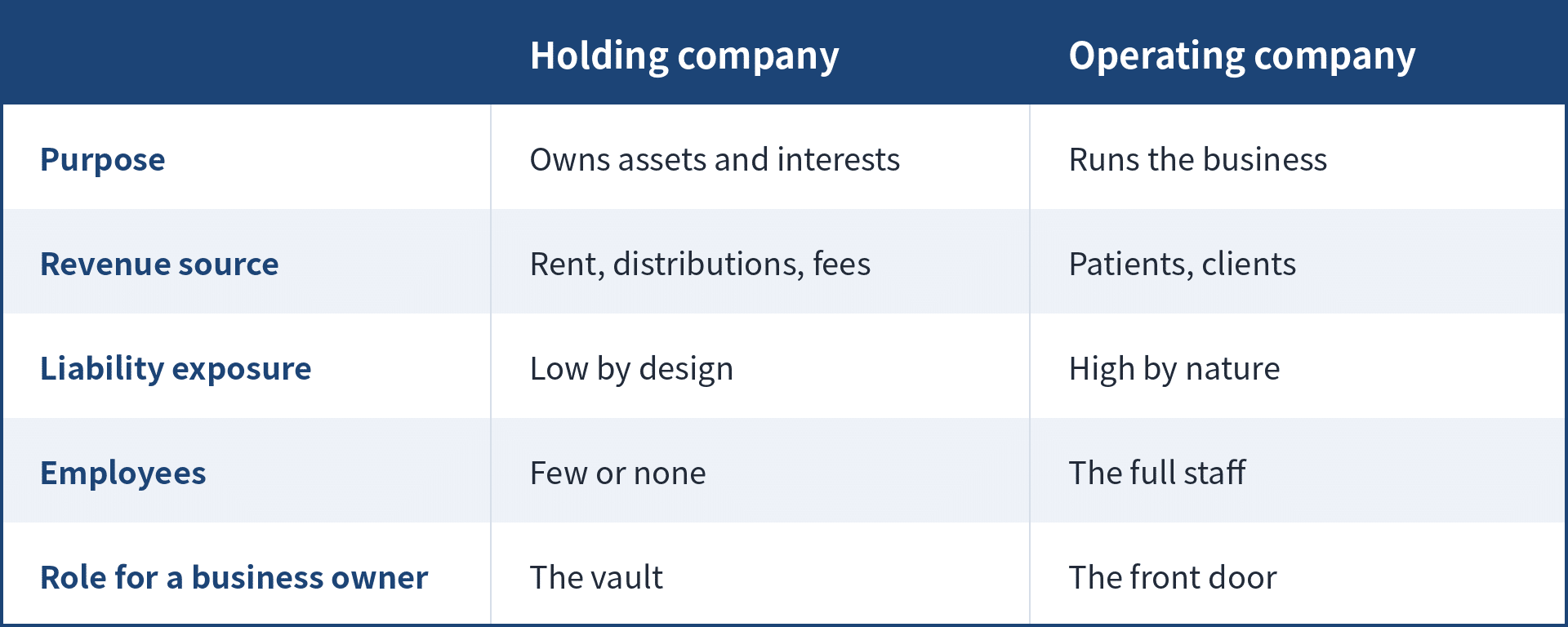
Can a Business Have Both?
Yes. For many established practice owners, that’s the point. The holding company typically owns the building and equipment, and the practice entity leases both back under a written agreement at a documented rate. In states with corporate practice of medicine rules, the practice entity is usually owned by the physician directly and sits alongside the holding company rather than beneath it.
Here’s how assets are often split. Imaging and surgical equipment typically sits in the holding company and is leased to the practice, since it’s high value and not a source of liability. Practice real estate commonly goes in the holding company or its own property LLC, because an appreciating asset is a target if left exposed. Retained cash above working capital is often moved to the holding company rather than kept where claims land. Rental property usually gets its own LLC beneath the holding company: separate risk, separate container. Patient contracts and payroll generally stay in the operating company, because they can’t be separated from the work.
This is the work Legally Mine does: reviewing what a client owns, identifying which assets belong outside the operating entity. We don’t give legal advice or form an attorney-client relationship. We build the structures, and attorneys handle the legal documents.
Most of what a practice owns does not need to sit where the risk is. Find out what can be moved, and when.

Make an Informed Decision for Your Business
The decision is rarely between a holding company and an operating company, it’s whether your current entity is still the right container for what you now own. Ask what it owns that it doesn’t need to, what a judgment could collect today, and whether that answer would differ from five years ago. If it makes you uncomfortable, the structure has fallen behind the balance sheet, a common, fixable gap in asset protection while no claim exists.
When a Holding Company May Be Liable for an Operating Company’s Debt
A holding company is not an automatic wall. Courts look past the structure in a handful of situations, all avoidable with discipline:
- It guarantees the debt, a signature makes the parent directly liable.
- The entities were never truly separate, shared accounts, commingled funds, and no minutes let a creditor pierce the veil.
- The subsidiary was deliberately underfunded, inviting the argument that it was a shell.
- The holding company directed the conduct at issue.
- Assets were moved after a claim appeared, which can be reversed as fraudulent conveyance.
Key takeaways
- A holding company owns assets and ownership interests; an operating company earns revenue and carries the liability.
- Equipment, real estate, and cash held inside the operating entity are exposed to every claim it faces.
- Many owners with significant assets use both: the operating company leases equipment and property from the holding company instead of owning them.
- Asset protection and liability protection only hold if each entity is funded, documented, and run as a genuinely distinct business.
- Corporate practice of medicine rules restrict who may own a medical practice, so the practice entity often sits beside the holding company rather than beneath it.
Your structure should reflect what you own now, not what you owned when you formed it. Schedule a free consultation.
Frequently Asked Questions
- Do I need a holding company if I already have an LLC? Not always. One LLC is enough while the business owns little of value. Once it holds real estate, expensive equipment, or significant retained cash, that single entity becomes one container with one lid, and any claim reaches all of it.
- Does a holding company replace my liability insurance? No. Insurance pays claims within its limits after something happens; a holding company provides liability protection by limiting what a claim can reach when coverage runs out or never applies. Most business owners need both liability protection and insurance, not one or the other.
Disclaimer
The information provided on this website does not constitute legal advice or tax advice. Customers of Legally Mine have no attorney-client privilege with representatives of Legally Mine, and no confidential relationship exists or will be formed by using its services. For personal legal or tax advice, please consult a licensed attorney or personal accountant.